“Manchevski imbues Kaymak with more meaning than a mere sex romp, exploring both the imperative to parent and the elastic strictures of monogamy… The performances in Kaymak are all excellent… The characters have lots of sex, both joyously kinky and cringingly transgressive. It gets very funny, and Manchevski even drops in a delicious nod to the Spaghetti Westerns of Sergio Leone.”
BIO
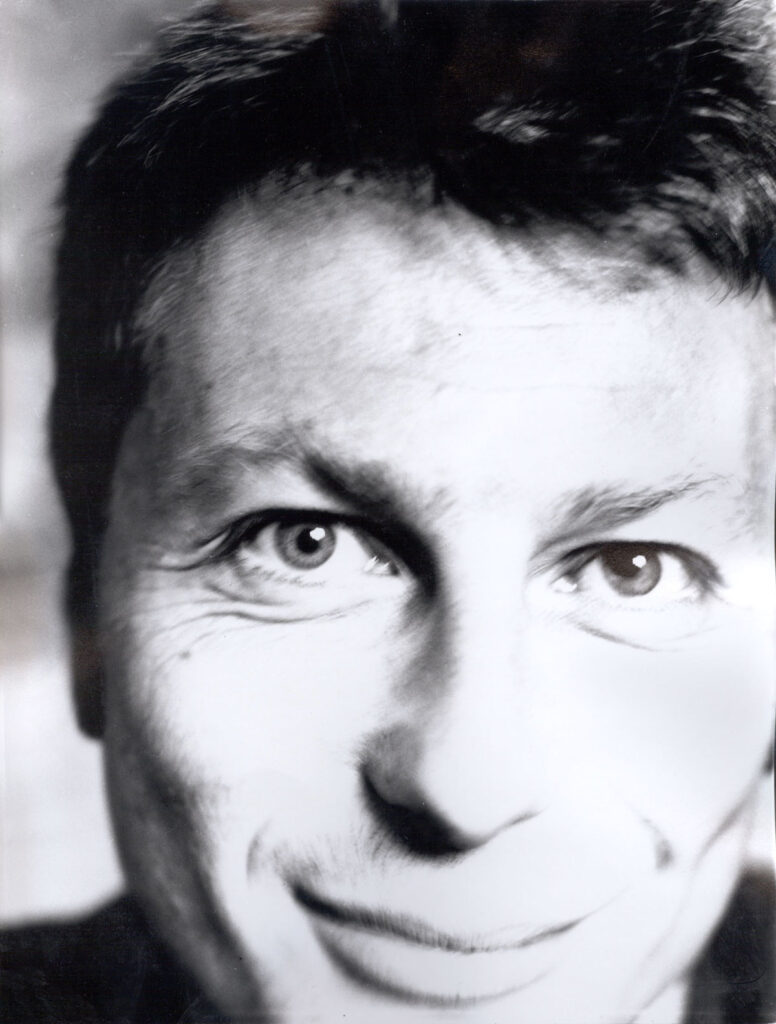
Milcho Manchevski wrote and directed eight features, one feature‑length documentary and a number of short forms. He has also authored books of photographs, fiction and non‑fiction, and has staged performance art.
Manchevski’s acclaimed debut Before the Rain (1994) is considered “one of the greatest debut feature films in the history of cinema” (Annette Insdorf) and “one of the most important films of the decade” (Ann Kibbey). The New York Times included it on its list “Best 1,000 Movies Ever Made.“ It won the Golden Lion in Venice, Independent Spirit, an Academy Award nomination, FIPRESCI, UNSECO, film of the year in Argentina, Sweden, Turkey, Italy and awards in Austria, Belgium, Brazil, Poland, Puerto Rico, Russia, etc.
“Manchevski continues down his distinctive artistic path” (Hollywood Reporter) with the award-winning features Dust (which opened Venice 2001), Shadows (2007), Mothers (2010), Bikini Moon (2017), Willow (2019), Kaymak (2022) and Sister Brother Manhole Cover (2026), more than 50 short forms, including The End of Time (2017), Thursday (2013), Macedonia Timeless (2010), 1.73 (1984), Arrested Development’s Tennessee (1991) and an episode of HBO`s The Wire (2002). They have been distributed globally, winning awards at Raindance, Cinequest, Valencia, Aspen, Fantasporto, FEDEORA, etc.
“Work like this keeps me going. A reminder of the nobility that film can attain.” (Roger Ebert) “His work stands out in world cinema for its unique way of playing with space, time and emotion.” (Keith Brown) “His unique blend of experimentation, poetry, emotion, and a demand for the active participation of the viewer in the construction of meaning are highly praised.” (Conor McGrady).
Manchevski’s work is the subject of numerous essays and books; it is part of the curricula at a few hundred universities and has been discoursed at a number of conferences. The University of Leipzig (Germany) and the European University Institute in Florence (Italy) hosted academic conferences dedicated, respectively, to Dust and Before the Rain.
Manchevski served as head of the Directing Studies at NYU’s Tisch School of the Arts’ Graduate Film program; he also taught at Feirstein Graduate School (Brooklyn College), EICTV (Cuba), VGIK (Russia), etc. He is a member of the Directors Guild of America, European Film Academy and the PEN Club.

Films
Shorts
Press Quotes
Kaymak
“Once again Manchevski creates moments of great emotional and plastic beauty, with gorgeous photography that manages to maintain formal unity, whether in the comic or dramatic register. The result is an extremely human and beautiful film, but also one that is sincere and raw. One more example of the great cinema of Milcho Manchevski.”
“[A] unique, tragi-comic experience”
“A distinct directorial voice… the courage to be daring”
“Erotic, satirical and sometimes hilarious”
“Masterful… one the rare contemporary artists in the world who passionately explore the human condition… a piece of art that transcends pure, unrestrained emotion that reaches deep”
“Masterful”
“BOLD.”
“Master of geometry of the naked human body […] Manchevski creates some of the most beautiful erotic scenes in contemporary European cinema – whether in the minor ghost key of “Shadows”, or in an almost-comedic plan in “Kaymak”… It doesn’t really matter, because we’re talking here about absolute values.”
“A cross-section of our today, a reflection in the mirror which should be unpleasant to behold; if we were we not vain and egocentric the reflection would have not disturbed us, a reflection which is neither idealized, nor banalized, but is rather merciless.”
“Milcho Manchevski is a visionary magician… He is a world name that has long outgrown the Balkans … When we talk about Manchevski, something moves us inside – a pleasant feeling that he is also “ours” (belonging to this cultural and geographical region), not just belonging to the world … Of the world filmmakers, Manchevski is among the Top 10, if not the Top 5, directors whose entire body of work has been presented during the years at Sofia Film Fest, just like Takeshi Kitano, the Kaurismaki brothers, like Mahmalbaf…”
“Manchevski is an artist with a fine sense for the hidden detail in “this unexplained world”… He loves the game, but not the frivolous game, but the one that requires to “get to work” (in his own words) to authentically recreate its spirit on the screen…”
“Although different from each other, his films have the potential to make up a larger film, where the separate “parts” exist and communicate. Thus the Skopje traffic in Shadows (2007) is reflected in the second and third parts of Willow (2019) or in Kaymak (2022) as in some surrealistic novel, that has emerged from the pen of some Murakami (Haruki, or even Ryu); the times echo from one movie to another, introducing us to a much more detailed picture of the world we live in; the Tower of Babel of local dialects and extinct languages gives us that sound that the modern film industry seems to have forsaken…”
“Many things in his films are just like this: small, fleeting, but cutting into our consciousness forever – echoes of a song on the radio in a noisy city; flashes revealing long-lasting truths about man and humanity; characters as eternal (as they are often revealed to us in different times and eras), as dynamic for interpretation. He lives with his characters without manipulating them. He leaves them to introduce themselves (“I’m a carpenter – like Jesus with tits,” as one of his characters says), he believes in their development from characters written on paper to complex characters, something are increasingly rare to see in cinema today. Even after a film is over, he gives his characters the charge to continue to live in the mind of the viewer in a larger meta-film.”
“A rare example of a creator who, in the cynical world we live in, remains primarily a humanitarian, without becoming less rock and roll”
“The universe of the couple and its possibilities are also explored in Kaymak by Milcho Manchevski, a bold and contemporary work… A story of feelings and attractions that is not afraid to deal with uncomfortable topics such as human trafficking and surrogacy.”
“KAJMAK features an extremely critical tone aimed at the capitalism of a wild kind, using as example of the incredible arrogance in the construction of Skopje, without any plan, taste and sensitivity for urban development that is reasonable and ecologically acceptable. In a series of his films, where the urban and rural (folklore, natural, organic, primal) touch, collide, or intersect to the detriment of the latter, Manchevski has shown a sensibility and intelligence, both visual and narrative, that no one in these ex-Yugoslavian spaces possesses.”
“The antagonisms of the two couples are portrayed not only through their mutual/ neighborly conflicts but also through the representation of class, way of life, and approach that leads each of them to this double maison à trois […]. The flip side of two unusual love stories are the antagonisms of Macedonian society, but also of the Balkans as a whole, which oscillate between the eternal dichotomies of rich and poor, modernity and tradition, urban and rural, West and East. Hinting on the classic tropes of the Balkans, the story in segments touches on the construction mafia, political corruption, religious fanaticism, and populist religiosity, but also uninhibited sexuality.”
“[Kaymak has] much wider implications […] some anthological sequences”
Willow
“Outstanding”
“One of those films that feels casual when you watch it, but digs deep and remains, both poignant and profound. Appealing storytelling … Extraordinarily affecting.”
“Subtle, profound…Three stories of Macedonian motherhood echo across eras in Milcho Manchevski powerful, evocative, beautifully played drama.“
“The complexity of this apparently simple film is how one story flows into the next, illuminating it in unexpected ways… Superbly atmospheric camerawork and a confident command of the camera … Dazzling …Sensual.“
“Manchevski masterfully weaves the threads of the three stories together… Visually, this is a lush film.”
“A multi-layered fictional exploration of fertility and infertility… Haunting and at times heartrending, Willow is exactly the kind of filmic poetry we can expect from Golden Lion winner and Academy Award nominee Milcho Manchevski.”
“Magical vision of the past whose fragments remain entangled in the present. An expert eye for photography.”
“A beautiful, poetic, thought-provoking film. The delicate narrative structure and profound motifs touch the audience’s souls.“
Bikini Moon
“Milcho, provocative as always, makes the most ingenious and tough comment on the information society.”
“Film director-philosopher.”
“We are invited to doubt everything we see.”
“Bikini Moon is a critique of the ideological dictatorship of reality shows and documentaries.”
“Astonishingly brilliant.”
“Provocative, multi-layered.”
“The viewer leaves the cinema both emotionally fulfilled and with a lot of food for thought.”
“Complex in its structure, experimental in its execution, this is poetic resistance to mass media cinema.”
“A brilliant auteur film… Positioned on the delicate line between fiction and documentary.”
“Uncompromising, critical art… Disturbing.”
“Arresting meditation on the documentary filmmaking process… lively, thought-provoking Bikini Moon edges in and out of the experimental category. The film is smart with a cool New York irony”
Mothers
“Painfully beautiful.”
“Daring, provocative, controversial.”
“Mothers opens up lines between documentary and fiction at the same time that it also blurs them. A special place in contemporary cinema.”
“Manchevski gradually reveals the corruption and the failure of the Macedonian investigative and judicial system. *…+ Manchevski‘s esthetic experiment proves successful and confirms his extraordinary talent as a storyteller of images and moods, his skills in directing actors of every age and his ability to suggest hints instead of verifying theories”
“Mothers is a very strange film, sometimes sophisticated, poignant and often elliptical. One of the most interesting and original filmmakers of recent years. One of those authors who are not afraid to face the genres and to push the boundaries.”
“Mothers is an operation completely extraneous to the conceptual and aesthetic codes of contemporary cinema. Manchevski’s epic humanism finally returns.”
“Mothers debunks the notion that documentaries can tell the truth.”
“Mothers is a film about moral courage.”
“Stylistically provocative.”
Shadows
“Shadows is a stunning and endlessly suspenseful erotic thriller. This mustsee artistry by director Milcho Manchevski leaves a magnetic imprint on the moviegoer”
“‚Call it a ‘ghost story’, but know that it feels more like Bergman or Polanski, or even Shakespeare – Macbeth and Hamlet come to mind. *…+ To live through these moments in this setting allows for an uncanny intimacy – a faceoff with personal fear that leads, strangely enough, to a celebration of life.”
“SHADOWS’ style runs between hypnotic and frantic, which will surely set hearts racing. The film is unique in its ability to have a hand in multiple genres.”
“A visual tale of dramatic substance, with historical depth and contemporary thrust, adroitly told with innovation and élan.”
Dust
“Manchevski is a cubist of the silver screen.”
“Rare visual intelligence.”
“A potent, assured and ambitious piece of filmmaking…There’s enough culture clash that Dust oesn’t need the equivalent of a Zen koan.”
“An extraordinary TransContinental, TransCentennial epic. Director Milcho Manchevski is a real original.”
“Manchevski uses diverse characters and a fragmented narrative structure to create a mosaic in which the details of history are subjective, contradictory, and illusory, and recollections are repeatedly altered to suit the desires of the storytellers.”
“An investigation into the nature of storytelling, twisting and fracturing his narrative and using jarringly disjunctive images to pull the past and present into a Moebius strip of cruelty, retribution and hope of heaven.”
“High-end surreal western‛”
Before The Rain
“One of the greatest debut feature films in the history of cinema”
“One of the most important films of the decade”
“Working in a sophisticated, elliptical style, mr. Manchevski brings to his film an overwhelming vision.”
“One of the best 1,000 movies ever made”
“Director Manchevski has made a debut so astonishingly assured in writing and technique he is guaranteed a footnote in movie history even if he never makes another movie. Before the rain is stunning. It is the sort of remarkable debut that reinstalls faith in the movies as genuine art.”
“A brilliant directorial debut. Work like this keeps me going. A reminder of the nobility that film can attain.”
“Stunning, often hypnotic… almost has the impact of a masterpiece… shakes you up… coming seemingly out of nowhere, it’s a movie that seems somehow fully formed, unshakably confident, the work of a filmmaker alive and inventive in every shot he takes.”
“Powerful and passionate… Its greatness rests in the timeless truths of its narrative… Some of the most luminous close-ups since ingmar bergman discovered color… Together, the filmmakers and performers create scenes of such emotional opacity that at times we seem to be reading tiny fluctuations of the soul.”
“Macedonian masterpiece”
“Master from Macedonia”
The End Of Time (SHORT FILM)
“Mesmerizing images […] Magnificent work”
“A study of the everyday and the secret deliverance that lies waiting, while no one is looking. A celebration of interbeing and the flux of the same afternoon coursing through each of our bodies.”
“For the idea, the inexorable elegance and mathematical beauty with which the film constructs a lyrical study of the optical unconscious.”
“I love this film very, very much! […] Great genius in capturing the truth of the world in only two shots. […] Masterpiece.”
“End of Time takes a single, insignificant situation out of everyday life and shows it as a sacred moment by slowing down the rhythm for sharper vision. The film’s crisp minimalism and commanding simplicity is truly moving.”
“An impressive minimalist phenomenology of time, consciousness and selfhood.”